It has taken time, but Salesforce's (NYSE: CRM) bottom has been reached, and the stage is set for a robust rebound. The SaaS apocalypse is not happening; Salesforce continues to gain traction, and its Q1 earnings results reveal that the virtuous cycle of AI is gaining momentum.
The virtuous cycle, driven by the bullish impact of AI spend, is reflected in results from NVIDIA (NASDAQ: NVDA) across the datacenter supply chain and into the service realm. When companies spend money on AI, it generates revenue and increases AI demand.
New spend equals new demand in an as-yet unending cycle. Because we are in the early phases of AI’s rollout, we can expect this cycle to sustain Salesforce's long-term growth.
Mixed Response Overshadows Bullish Outlook for CRM
Analysts had a mixed response to the Q1 results, with numerous negative price target revisions offset by reaffirmed and target increases. The net result, however, was bullish, as the 39 analysts MarketBeat tracks carry a 72% Buy-side bias, and revisions are clustered around the consensus. While some push the lower end, many are in the high end, with the average of $240 just below the broader 12-month consensus price target. The consensus assumes nearly 50% upside from the critical support target, which, coincidentally, aligns with the lowest analyst targets. The consensus of fresh targets implies a 35% upside and a five-month high.
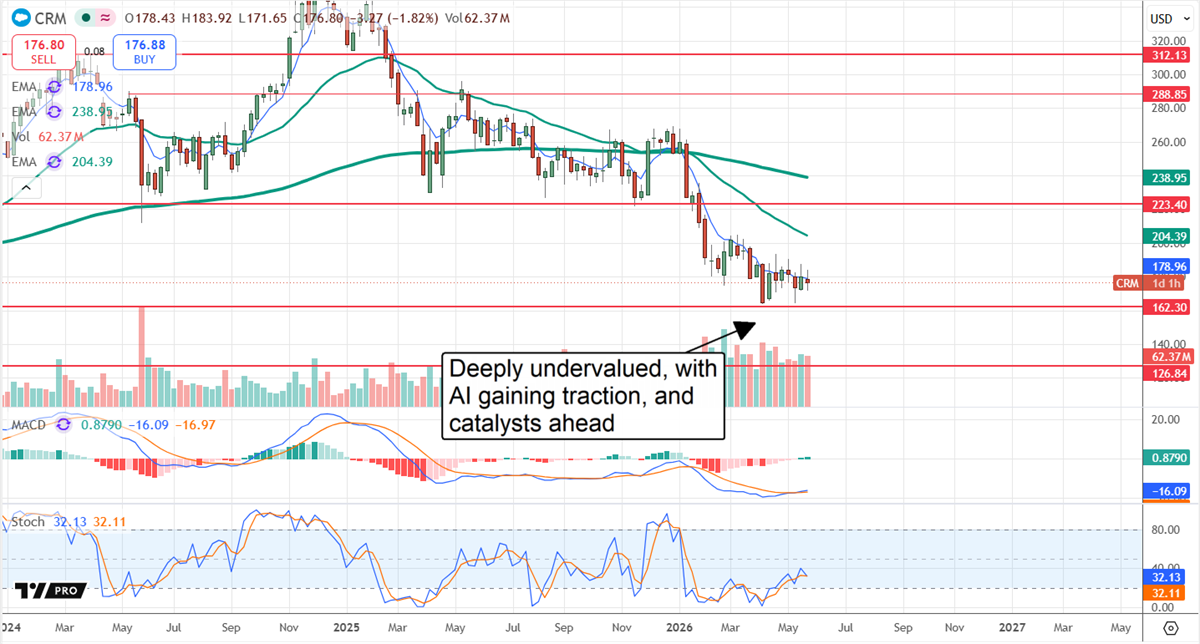
Technical stock price and institutional trends also align with the critical support target around $160, which reflects high set in 2019 prior to the COVID-19 pandemic. Price action since has been volatile, driven by stimulus spending and accelerated digitization, but the stock has continued to show support at this level, as it does in late May. Support is seen in the weekly price candles and indicators, which reflect bears losing control and bulls regaining it.
Institutional trends reveal high ownership and aggressive accumulation. The group owns more than 80% of the stock, has bought on balance for 10 consecutive quarters, and has ramped up activity as the stock price has fallen. Bullish activity persisted into early Q2 2026, and will likely continue the trend as the year progresses. The stock trades at a ridiculously low 12X the current-year earnings with growth accelerating under the influence of AI. Assuming the forecasts are right, the company can rise 200% in the near term and then double again over time, given the right catalysts.
Salesforce Posts Tepid Results, But Versus a High Bar
Salesforce’s Q1 results and guidance were tepid relative to the analysts' forecasts, but the bar was set high, and results were strong. The company’s $11.31 billion in net revenue is up 13.2% year-over-year, accelerating both quarterly and compared to the prior year, with growth the strongest it's been in three. Results were underpinned by Agentforce, the agentic platform, which saw annual recurring revenue grow by more than 200%. Consumption, a critical factor, was also strong, rising by more than 110% sequentially, and Data 360 handled a 136% increase in records.
Margin news was also solid. The company reported gains across the board, with adjusted earnings rising 50% year over year (YOY) to $3.88, topping the consensus by 75 cents. More importantly, guidance was also solid, with the company forecasting another quarter of strength. Growth is expected to slow to just over 10%, but guidance is likely cautious. The more critical detail is that earnings are expected to outpace expectations by a wide margin, and may also be a cautious guide.
Among the factors highlighting the company’s strength is its financial position and capacity for capital return. The company initiated an accelerated $25 billion repurchase agreement, which is largely complete. The impact was a 10% YOY decline in the diluted share count, with the expectation of continued aggressive capital returns. Dividends are also part of the equation, yielding almost 1% as of late May, with annual distribution increases expected. As it stands, the balance sheet remains fortress-like, with ample cash and low leverage, enabling the execution of strategy and delivery of results.
Analysts waiting to “see more” in Salesforce’s results may be missing the point. The company’s primary catalysts are AI integration, margin improvement, and capital returns, and it delivered on all three. With this in play, CRM’s stock price may struggle to move higher, but that is unlikely. The likely outcome is that upcoming results turn more naysayers into supporters, helping to firm market sentiment. Until then, this stock may wallow near its current lows but is not expected to fall below them.