
Stock of the Day

September 3, 2026

Walmart (WMT)

$106.09
+$0.17 (+0.2%)
Market Cap: $840.34B

About Walmart

Walmart Inc. engages in the operation of retail, wholesale, other units, and eCommerce worldwide. The company operates through three segments: Walmart U.S., Walmart International, and Sam's Club. It operates supercenters, supermarkets, hypermarkets, warehouse clubs, cash and carry stores, and discount stores under Walmart and Walmart Neighborhood Market brands; membership-only warehouse clubs; ecommerce websites, such as walmart.com.mx, walmart.ca, flipkart.com, PhonePe and other sites; and mobile commerce applications. The company offers grocery and consumables, including dairy, meat, bakery, deli, produce, dry, chilled or frozen packaged foods, alcoholic and nonalcoholic beverages, floral, snack foods, candy, other grocery items, health and beauty aids, paper goods, laundry and home care, baby care, pet supplies, and other consumable items; fuel, tobacco and other categories. It is also involved in the provision of health and wellness products covering pharmacy, optical and hearing services, and over-the-counter drugs and other medical products; and home and apparel including home improvement, outdoor living, gardening, furniture, apparel, jewelry, tools and power equipment, housewares, toys, seasonal items, mattresses and tire and battery centers. In addition, the company offers consumer electronics and accessories, software, video games, office supplies, appliances, and third-party gift cards. Further, it operates digital payment platforms; and offers financial services and related products, including money transfers, bill payments, money orders, check cashing, prepaid access, co-branded credit cards, installment lending, and earned wage access. Additionally, the company markets lines of merchandise under private brands, including Allswell, Athletic Works, Equate, and Free Assembly. The company was formerly known as Wal-Mart Stores, Inc. and changed its name to Walmart Inc. in February 2018. Walmart Inc. was founded in 1945 and is based in Bentonville, Arkansas.

Walmart Bull Case

Here are some ways that investors could benefit from investing in Walmart Inc.:

  • Walmart Inc. recently reported strong quarterly results on August 20th, 2026, beating analyst expectations with an earnings per share of $0.81 compared to the consensus estimate of $0.74, while also exceeding revenue forecasts with $187.94 billion in sales, demonstrating robust operational performance and demand for its goods.
  • The stock currently trades at $106.09, which is significantly below the consensus price target of $138.50 set by analysts as of August 21st, 2026, suggesting substantial potential for price appreciation as the market re-evaluates the company's valuation relative to its earnings growth.
  • Walmart Inc. maintains a low beta of 0.59, indicating that its stock price is less volatile than the broader market, which can provide a defensive characteristic for investors seeking stability in their portfolios during periods of market uncertainty.
  • The company has a consistent track record of beating earnings estimates, having also exceeded expectations in the previous quarter on May 21st, 2026, with an EPS of $0.66 against a consensus of $0.659, reinforcing confidence in its ability to deliver reliable financial results.
  • Walmart Inc. offers a dividend yield of 0.93%, providing a modest income stream for investors, while its market capitalization of approximately $840 billion reflects its status as a large-cap, blue-chip company with significant market presence and liquidity.

Walmart Bear Case

Investors should be bearish about investing in Walmart Inc. for these reasons:

  • Walmart Inc. has issued conservative guidance for the third quarter of fiscal 2027, projecting an EPS of $0.620 to $0.640, which is below the consensus estimate of $0.680, potentially signaling slower growth or margin pressures ahead that could disappoint investors expecting higher earnings.
  • The stock has experienced a decline of 9.38% over the past 90 days, indicating a recent downward trend in investor sentiment and price performance that may reflect broader market concerns or specific company-related challenges affecting its valuation.
  • Walmart Inc. faces regulatory scrutiny, as the Department of Justice has expanded its beef price investigation to include the company, which could lead to legal costs, operational restrictions, or reputational damage that negatively impacts its business operations and profitability.
  • Several institutional investors, including Northwestern Mutual Wealth Management Co. and Royal London Asset Management Ltd., have reduced their positions in Walmart Inc. during the second quarter, suggesting that large holders may be losing confidence in the stock's near-term prospects or reallocating capital to other opportunities.
  • The company's price-to-earnings ratio of 38.30 is relatively high compared to its historical averages, which may indicate that the stock is overvalued relative to its current earnings, leaving little room for error if future earnings growth does not meet elevated expectations.

Walmart's Post-Earnings Drop Could Be a Buying Opportunity

Written By Thomas Hughes on 8/20/2026

Walmart storefront with illuminated logo and sign at dusk, with a shopping cart in the parking lot.

Walmart’s (NYSE: WMT) near-term hurdle is weaker-than-expected Q2 sales in North America. The issue, foreshadowed by weak July retail sales, led to a 5% price drop, taking the stock to near its 52-week low.

That is the opportunity: the 52-week low and potential for long-term gains. While the near-term hurdle exists, it is offset by sustained growth and improved profitability, which is the critical factor. Walmart is a big business; more than moderate growth is unlikely given its size and scale, and its cash flow is the key. Cash flow enables healthy capital returns, which drive the stock price higher over time.

Walmart’s capital return is incredibly reliable, backed up by healthy insider ownership centered on the founding family. They run Walmart in their own interests: to produce healthy cash flow and pay themselves to own it.

As it stands, Walmart is a Dividend King with more than 50 years of consecutive annual increases on its record, a signal that it can withstand economic changes and sustain its capital return over time.

The yield isn’t impressive at under 1%, even with the Q3 price pullback, but it is as safe as they come, amounting to less than 35% of the current-year earnings forecast and compounded by share buybacks. Walmart’s share buybacks drive most returns, accounting for 56% of Q2 activity. They reduce the share count incrementally each quarter, providing shareholders with leverage as the company grows and builds equity.

Walmart Outperforms in Q2, Raises Guidance

Walmart’s near-term headwind isn’t as big a problem as it may seem, given its Q2 strengths. The company’s push into international markets and its advertising business helped offset domestic weakness, resulting in $187.94 billion in net sales, up nearly 6% year over year and $1.12 billion above expectations. Segmentally, U.S. comp sales increased 2.6% on traffic and tickets, International grew 12.8%, and Sam’s Club grew 8.8%.

Internally, ecommerce continues to drive sales, up approximately 23%, while the ad business is growing rapidly. It advanced by 38%, with 38% growth in the United States, and is expected to remain strong and drive margin long into the future. Membership is another strength, up 17% year over year (YOY), driven by gains in Sam’s Club and Walmart+. Walmart+ is a premium tier enabling enhanced shopping experiences, free delivery, shipping, and streaming services.

Margin was the better part of the Q2 report. While IEEPA tariff refunds affected the GAAP results, even the adjusted figures revealed improvement. The company widened gross and operating margins, driving a nearly 29% increase in operating income, 17.9% adjusted, and sufficient cash flow to sustain the capital return outlook.

Guidance is another hurdle, as it came in slightly below MarketBeat’s consensus for Q3 and full year results. However, the company improved its previous forecast, expecting mid-single-digit top-line growth and modestly accelerated earnings growth.

Walmart Analysts See 30% Upside Despite Near-Term Pressure

Walmart’s analysts are bullish on the stock, having issued numerous affirmations and price targets in the weeks leading up to the release. The trend includes steady coverage by 36 analysts, a firm Moderate Buy consensus rating with 86% Buy-side bias, and a $138.50 consensus price target.

The good news is that consensus forecasts about a 30% upside relative to the critical support target; the bad news is that July/August activity created a top in the price-target trend, which may turn into a retreat. In this environment, WMT’s stock price has upside but is unlikely to advance until analysts revert to a more optimistic posture. Looking ahead, WMT’s rebound may be sharp and sweet when it triggers, as the stock trades below the low-end analyst target as of mid-August.

Institutional Buying Could Put a Floor Under Walmart Stock

Meanwhile, institutional activity suggests the downside risk is limited. The group owns 25% of the stock, a seemingly small amount, but it's offset by high insider holdings above 50%.

MarketBeat data shows that institutional buyers outpaced sellers $3-to-$1 over the trailing 12 months, with buying activity spiking in early Q3. With this in play, the group will likely buy on price dips and may provide solid support near $105.
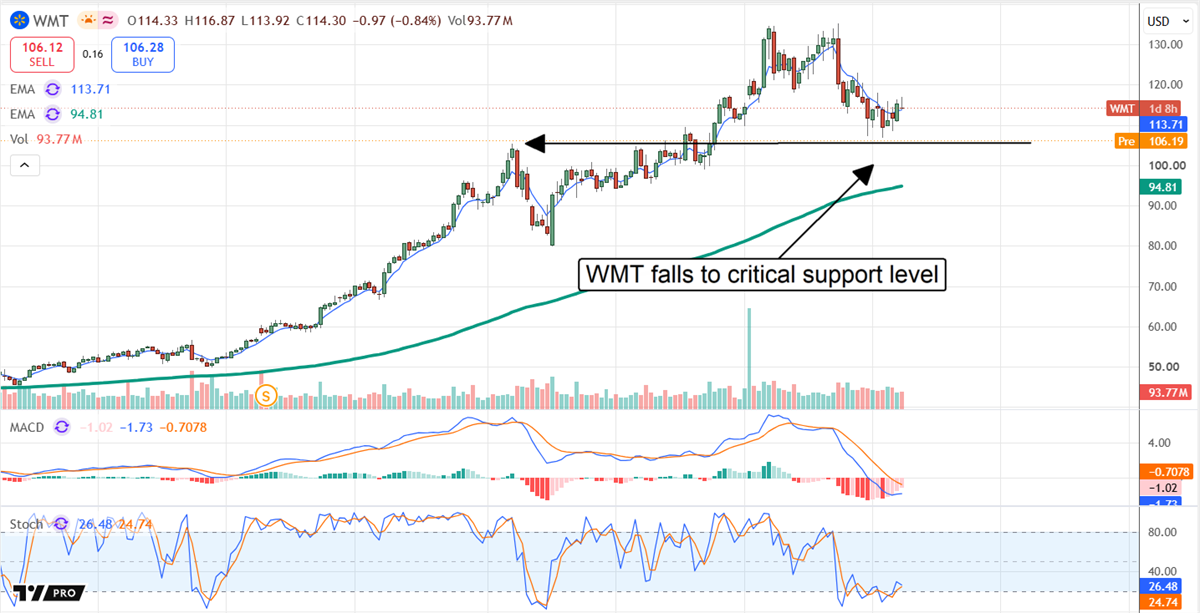
WMT chart showing the stock price at $106.19, with an annotation identifying that level as critical support.

Early price action wasn't favorable following the Q2 release, with the stock down more than 5% in premarket trading. The question is whether Walmart confirms support in the subsequent sessions or moves lower, presenting its buying signal sooner rather than later.

Recent News