Stock of the Day

October 13, 2026

Microsoft (MSFT)

$541.15
+$6.08 (+1.1%)
Market Cap: $3.97T

About Microsoft

Microsoft Corporation develops and supports software, services, devices and solutions worldwide. The Productivity and Business Processes segment offers office, exchange, SharePoint, Microsoft Teams, office 365 Security and Compliance, Microsoft viva, and Microsoft 365 copilot; and office consumer services, such as Microsoft 365 consumer subscriptions, Office licensed on-premises, and other office services. This segment also provides LinkedIn; and dynamics business solutions, including Dynamics 365, a set of intelligent, cloud-based applications across ERP, CRM, power apps, and power automate; and on-premises ERP and CRM applications. The Intelligent Cloud segment offers server products and cloud services, such as azure and other cloud services; SQL and windows server, visual studio, system center, and related client access licenses, as well as nuance and GitHub; and enterprise services including enterprise support services, industry solutions, and nuance professional services. The More Personal Computing segment offers Windows, including windows OEM licensing and other non-volume licensing of the Windows operating system; Windows commercial comprising volume licensing of the Windows operating system, windows cloud services, and other Windows commercial offerings; patent licensing; and windows Internet of Things; and devices, such as surface, HoloLens, and PC accessories. Additionally, this segment provides gaming, which includes Xbox hardware and content, and first- and third-party content; Xbox game pass and other subscriptions, cloud gaming, advertising, third-party disc royalties, and other cloud services; and search and news advertising, which includes Bing, Microsoft News and Edge, and third-party affiliates. The company sells its products through OEMs, distributors, and resellers; and directly through digital marketplaces, online, and retail stores. The company was founded in 1975 and is headquartered in Redmond, Washington.

Microsoft Bull Case

Here are some ways that investors could benefit from investing in Microsoft:

  • Microsoft unveiled its third-generation Maia 300 AI processor, which management claims can deliver approximately 40% more AI-generated tokens per megawatt than leading GPU-based systems, potentially improving Azure margins and reducing dependence on external chip suppliers like Nvidia.
  • The company recently reported strong financial results with revenue of $90.01 billion, beating analyst expectations, and earnings per share of $4.74, which exceeded the consensus estimate of $4.24, demonstrating robust operational performance and profitability with a net margin of 40.31%.
  • Microsoft has increased its quarterly dividend to $0.98 per share, representing a 0.7% yield and a positive change from the previous $0.91 payment, signaling continued commitment to returning capital to shareholders while maintaining a low payout ratio of 21.83%.
  • Analysts maintain a consensus rating of Moderate Buy with an average price target of $579.84, which suggests potential upside from the current stock price of $541.15, supported by bullish commentary on Azure growth and rising Copilot usage.
  • The stock has demonstrated strong momentum, trading at $541.15 on October 12, 2026, which is a significant increase from its 52-week low of $349.20, reflecting investor confidence in the company's strategic pivot toward in-house silicon and AI infrastructure efficiency.

Microsoft Bear Case

Investors should be bearish about investing in Microsoft for these reasons:

  • Corporate insiders have been selling shares, with CEO Satya Nadella and EVP Amy Hood both executing sales in September 2026 under pre-arranged trading plans, resulting in a total of 143,009 shares sold by insiders in the last three months, which may signal reduced internal confidence or personal financial planning.
  • Microsoft faces regulatory and political headwinds, as the Trump administration suspended the company from the PERM green card program, with Vice President JD Vance accusing the firm of replacing laid-off Americans with foreign workers, creating potential operational and reputational risks.
  • The company's valuation is relatively high with a price-to-earnings ratio of 30.13, which may limit upside potential if growth in Azure or AI services slows, particularly as investors await the October 28 earnings report to confirm that Azure growth remains above 40%.
  • Microsoft is committing to significant capital expenditures for AI infrastructure, including multi-gigawatt deployments of the Maia platform, which could pressure free cash flow and require substantial ongoing investment to maintain competitive advantage in the AI race.
  • Short interest has increased in recent months, with shares shorted rising to 61,133,927 as of September 30, 2026, indicating that some market participants are betting against the stock's performance, potentially due to concerns over high valuation or execution risks in its AI strategy.

Microsoft Is Almost Back to $555—Now the Hard Part Begins

Written By Chris Markoch on 10/9/2026

Microsoft logo displayed over an illuminated glass office building at dusk, reflected in a water feature.

Microsoft Corporation (NASDAQ: MSFT) stock is closing in on familiar territory. Shares traded around $530 this week. That puts MSFT within 5% of its 52-week high of $553.72.

That's a remarkable turnaround. Microsoft gained about 37% in the third quarter of 2026. It was the company's best quarterly performance since 1998. In late June, shares were trading around $372.

But the easy part of this rally may be over. The next leg is less about Microsoft's business and more about investor psychology.

MSFT peaked near $555 in October 2025. It then spent roughly eight months falling. At the bottom, a $10,000 investment made at the peak was worth about $6,510. Many of those investors are finally close to breaking even.

That creates a different kind of test for MSFT stock. Investors tend to sell winners too early and hold losers too long. When a losing position finally gets back to even, the urge to sell can be overwhelming.

Microsoft's fundamentals have earned this rally. Now the stock has to work through a wall of breakeven sellers. And it has to do that heading into an earnings report where expectations are much higher than they were three months ago.

Q4 Turned a Pariah Into Wall Street's Darling

It's hard to overstate how fast the narrative changed. Heading into July, the story around Microsoft was capital expenditures (CapEx) fatigue. Investors questioned whether its massive AI spending would ever earn an adequate return.

Then Microsoft reported fiscal fourth-quarter 2026 results on July 29. Revenue came in at $90 billion, up nearly 18% year-over-year. Azure crossed $100 billion in annual revenue for the first time. Earnings per share (EPS) of $4.74 topped the $4.24 consensus estimate.

The stock jumped about 15% the next day. It was Microsoft's biggest single-day gain since 2008.

Analysts have followed the price higher. Stifel upgraded MSFT to Buy in late September. On Oct. 5, Melius Research upgraded the stock to Buy with a $665 price target. Scotiabank raised its target to $615 from $510.

This is the same company, with largely the same AI strategy, that investors were avoiding in the spring. What changed was perception. In other words, the numbers gave investors permission to believe again.

Why $555 Is a Psychological Level, Not Just a Technical One

Most investors will see $553.72 as resistance on a chart. That's true, but it misses the behavioral story behind the number.

Think about who owns MSFT at that level. Many bought during the AI enthusiasm of late 2025. Some added on the way down, convinced the sell-off was overdone. Others simply held through a drawdown of roughly 35%.

Behavioral economists call the tendency to sell winners and hold losers the disposition effect. A related bias, sometimes called "get-evenitis," keeps investors anchored to their purchase price. Once a stock gets back there, the relief of not losing money often beats the hope of more gains.

That doesn't mean Microsoft can't break through. It means the stock needs a reason to absorb that supply. Momentum alone may not be enough. A fresh catalyst usually does the job. For Microsoft, that catalyst is its Q1 earnings report for fiscal year 2027 (FY2027).

Earnings Will Have to Clear a Higher Bar

Microsoft hasn't confirmed its next earnings date, but the report date is estimated for Oct. 28. The headline number will be Azure growth. Management guided for growth of about 45% in the quarter.

Three months ago, a number like that would have looked like upside. Now it's closer to the baseline. With the stock up nearly 40% in a quarter, investors may want more than a match.

There's also some fine print in last quarter's beat. The $4.74 EPS figure included a $3.2 billion gain on Microsoft's Anthropic stake. That's a real gain, but it isn't a repeatable operating result.

Spending remains part of the debate, too. Quarterly capital expenditures roughly doubled year-over-year, and free cash flow fell about 23%. Management also expects CapEx to grow again in fiscal 2027.

None of this breaks the bull case. CFO Amy Hood said in July that demand still exceeds available capacity. But it does mean the stock has less room for a merely good quarter.

Chasing MSFT at $530 Is a Different Trade

For long-term investors, Microsoft's story looks stronger than it did six months ago. Its AI investments are showing up in revenue, and Wall Street sentiment has turned firmly bullish.

But buying MSFT at $530 isn't the same trade as buying it at $372. At roughly 30x trailing earnings, the stock is priced for steady execution. The margin for error is thinner.
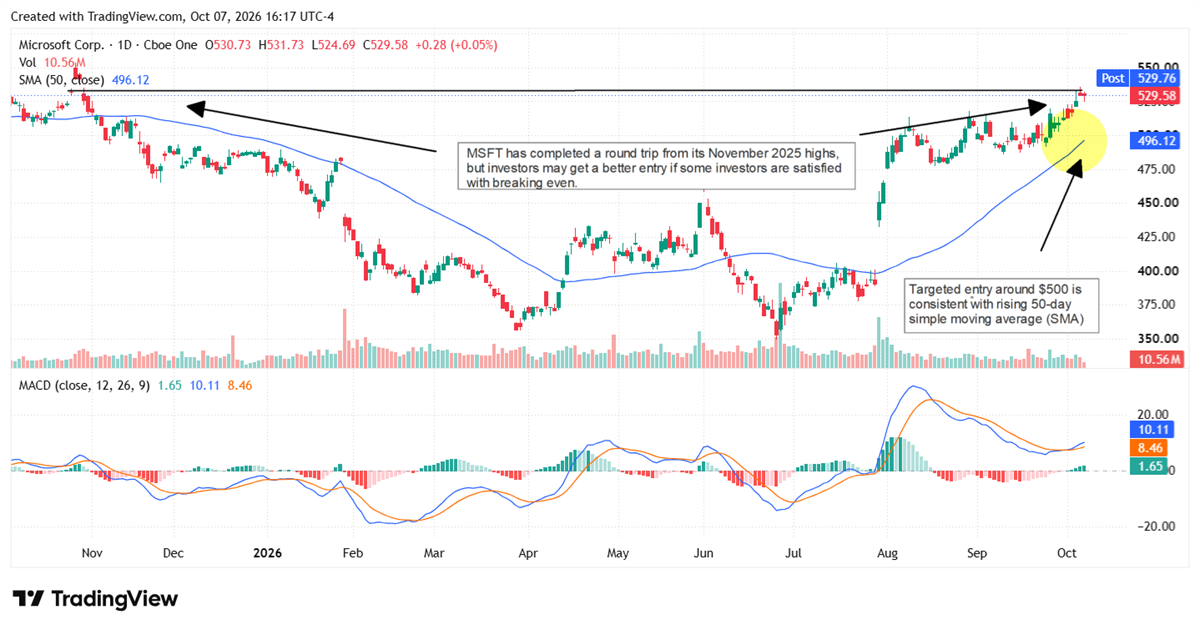
TradingView chart of Microsoft Corp stock price with moving average and MACD indicator showing a pullback from highs.

Investors who want exposure may be better served by scaling in. A pullback toward $500, where the stock consolidated in late September, would offer a more comfortable entry. A decisive close above $553.72 on strong volume would confirm a breakout.

If MSFT stalls near its old high, don't read it as a verdict on the business. It may simply be breakeven investors heading for the exits. Once they're gone, the path higher could get a lot easier.

Recent News