
Coca-Cola’s (NYSE: KO) Q4 2025 results and guidance update failed to trigger a rally but revealed numerous reasons why this consumer discretionary stock could continue to trend higher this year. Among the reasons is improvements in free cash flow, which could impact the dividend payment.
While a one-off expense impacted free cash flow in 2025, resulting in a negative free cash flow payout ratio, that situation will not be repeated. Not only was 2025 adjusted free cash flow sufficient to cover dividends, buybacks, and more, but the forecast calls for an accelerated 7% growth in 2026 and a persistently healthy capital return.
Capital returns are central to KO’s stock price outlook. This company, a Dividend King, has increased its distribution for over 60 years and has the capacity to continue with annual increases for the foreseeable future.
The payout ratio is a tad high, near 70%, but it is a sustainable rate, given the earnings outlook and balance sheet health.
Earnings are forecast to grow slightly faster than revenue over the next five to 10 years, running a moderately high single-digit CAGR, with share buybacks also in the equation. Buybacks aren’t aggressive, but they offset the dilutive impact of share-based compensation and reduce the count incrementally each year. Buyback activity in Q4 amounted to approximately 0.12% of the market cap; the full-year activity was comparable.
Coca-Cola Pulls Back on Mixed Results
Coca-Cola Company issued a mixed Q4 report, but the beauty is in the eye of the beholder. While revenue fell short by 200 basis points, margins were resilient, and the bottom-line performance was strong. Organically, Coca-Cola grew by 5% on a 4% increase in concentrate sales, a 1% gain in price/mix, the timing of payments, and an extra day in the quarter. Unit case sales grew by 1% while foreign exchange rates were a headwind.
Margin news was also mixed, but it favors investors. The company logged a significant margin contraction attributed to the aforementioned one-off expense; however, adjusted results were much stronger, and growth remains present.
Critical takeaways include a 32% quarterly decline in operating income offset by a 38% annual increase, and adjusted earnings of 58 cents, which are up 6% compared to the tepid 2.6% top-line advance and more than 350 bps better than analyst consensus.
Guidance was a concern, but one unlikely to linger. The company’s guidance was slightly short of consensus, forecasting 4.5% growth. However, analyst trends suggest a weak guide was expected.
MarketBeat tracked a single analyst update within the first hours of the release, affirming the consensus Buy rating and raising the price target. The new Wells Fargo target is a 10% increase to $87, aligning with the high-end range and a forecast of more all-time highs this year.
Institutional Activity Signals Accumulation for KO Stock
Institutional data reveals the group is accumulating KO stock in 2026. Institutions provide a solid support base, owning more than 70% of the stock. The tailwind due to institutional buying activity was strong in early 2026, as they bought more than $2 for every $1 sold. This tailwind could strengthen following the mid-February stock price pullback, which was triggered by the 2026 guidance update.
The post-release price action was as mixed as the release itself. The market pulled back more than 1.5% at the open the day after the release, signaling a peak in the action, but buyers stepped in at that level to support the price.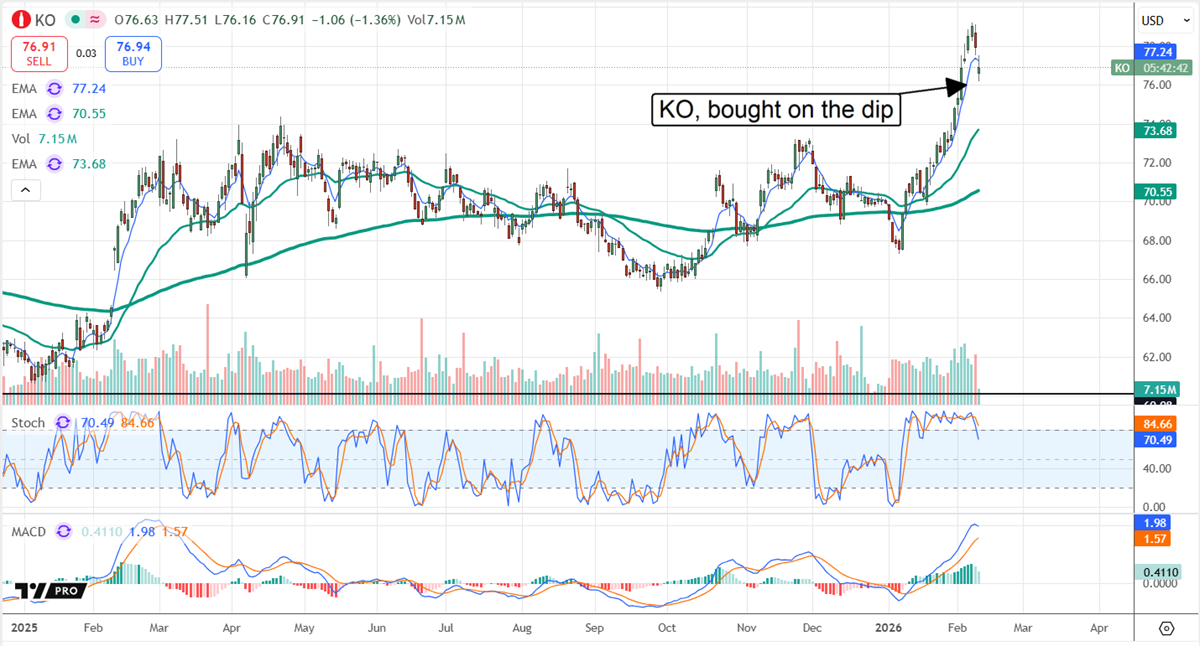
The takeaway is that KO’s uptrend is intact, February’s pullback triggered a buying spree, and higher prices are indicated. Assuming KO consolidates at current levels before its next advance, near-term upside could run in the $7 to $10 range from the early February high, aligning this market with analyst sentiment.