For sports fans, March is one of the best times of the year because of the NCAA men’s and women’s basketball tournaments, colloquially known as March Madness. It’s also a favorite of those who like to bet on sports.
Analysts are forecasting that up to $4 billion could be spent at U.S. sportsbooks for this year’s tournament. For those who view the world through an investor lens, that signals a potential opportunity.
Some of the growth expectations are being fueled by the expansion of legal wagering across more states. This year, that opportunity is even more intriguing due to the popularity of prediction markets. These allow participants to buy and sell contracts on the outcome of future events. The price of each contract reflects the perceived likelihood of the event occurring.
The concept of prediction markets is not new. But the internet and blockchain technology have revolutionized the industry by solving inherent problems of regulation and trust. In fact, the 2024 presidential election was one of the first examples of prediction markets becoming part of the national conversation.
The boom has also created an explosion of companies looking to capture this business. However, many pure-play prediction market companies are not publicly traded. But there are exceptions, and with so much attention flowing into the prediction markets, it’s not surprising to see several traditional gaming stocks getting into the prediction markets game.
Robinhood Expands Prediction Markets Inside Its Trading Platform
Robinhood Markets Inc. (NASDAQ: HOOD) is becoming one of the most well-known names in the prediction markets. The company’s SuperApp is blurring the lines between stock trading, crypto, and, increasingly, prediction markets.
Robinhood offers a leveraged way to play the growth of prediction markets within a diversified, profitable trading platform rather than a single-purpose venue. For example, in its most recent earnings report, Robinhood showed that prediction markets revenue is already annualizing at $435 million.
That revenue now makes up about 10% of the record $4.5 billion in revenue that Robinhood achieved for its full fiscal year 2025, up 52% year-over-year (YOY). For the fourth quarter, the company’s revenue of $1.28 billion and earnings per share of 66 cents were both at record levels.
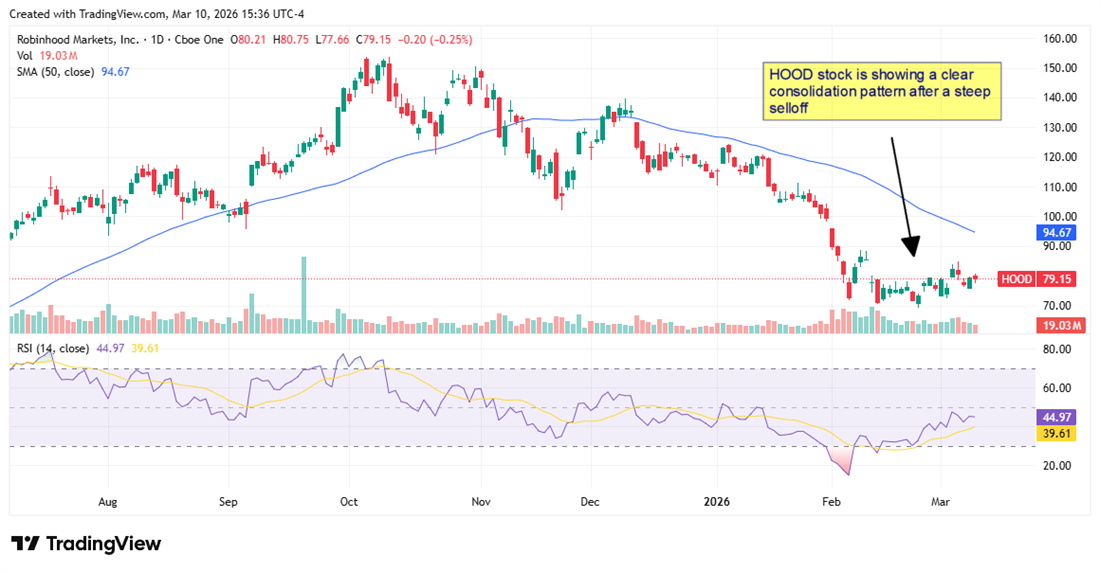
That hasn’t done much to help HOOD stock, which is down 30% in 2026. The stock looks to have formed a bottom, though, and is consolidating for a potential break higher. Analysts give the stock a consensus price target of roughly $120, representing more than 50% upside from recent levels.
DraftKings Brings Prediction Markets Directly Into Sports Betting
Give the people what they want. That may not be exactly what DraftKings Inc. (NASDAQ: DKNG) was thinking when it announced plans to launch “DraftKings Predictions” in 2026. The company is planning exclusive integrations across ESPN and NBCUniversal to embed betting and predictions directly into how fans consume live sports.
Investors shouldn’t look at this as a company playing catch-up. DraftKings is leaning into prediction markets at a time when the company’s underlying engagement is accelerating. In its last earnings report, the company reported that season-to-date sportsbook hold and net revenue margin have expanded alongside a rising parlay mix. This reinforces the potential that comes from adding a prediction markets customer base that is similar, but not identical to its traditional sportsbook bettors.
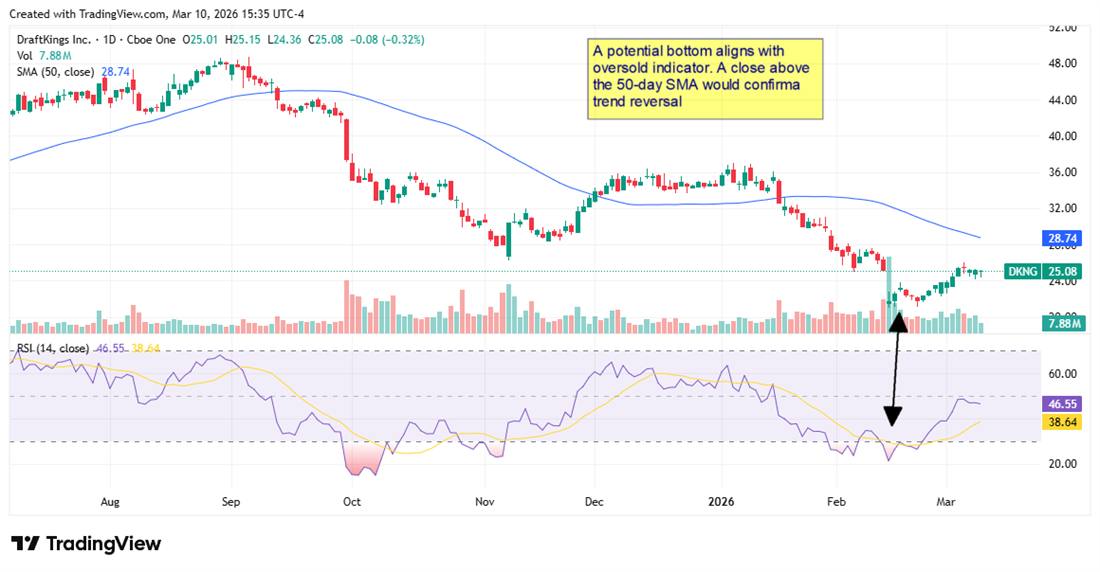
Much like HOOD stock, DKNG stock is down 27% in 2026, which continues a downtrend that began in late summer 2025. It also tracks with a broad downtrend in consumer discretionary stocks. That said, the stock does look like it’s found a bottom, but investors will want to see it recapture its 50-day simple moving average (SMA) for confirmation of the bullish reversal.
FanDuel Owner Flutter Targets Prediction Market Growth
Flutter Entertainment plc (NYSE: FLUT), the parent company of FanDuel, is also entering the prediction markets from a position of strength. The company is the world’s leading online sports betting and iGaming operator. In the United States, FanDuel holds roughly 41% online sportsbook gross gaming revenue share and 28% iGaming share, and Flutter is treating prediction markets as a significant incremental total addressable market expansion rather than a substitute for betting.
Flutter generated 16.4 billion euros ($19.04 billion) in 2025 revenue and served nearly 16 million average monthly players across brands like FanDuel, Sky Bet, PokerStars, and Paddy Power. Group revenue grew 17% last year, with adjusted EBITDA up 21% to €2.85 billion ($3.31 billion) as Flutter leveraged its scale, technology, and “Flutter Edge” data platform across markets.
The recently launched FanDuel Predicts already offers sports contracts in 18 states and non-sports contracts nationwide, with early engagement skewed heavily to sports and average volume per customer tracking to expectations. Management expects to invest up to €300 million ($348 million) to build FanDuel Predicts ahead of the 2026 World Cup and 2026–27 NFL season.
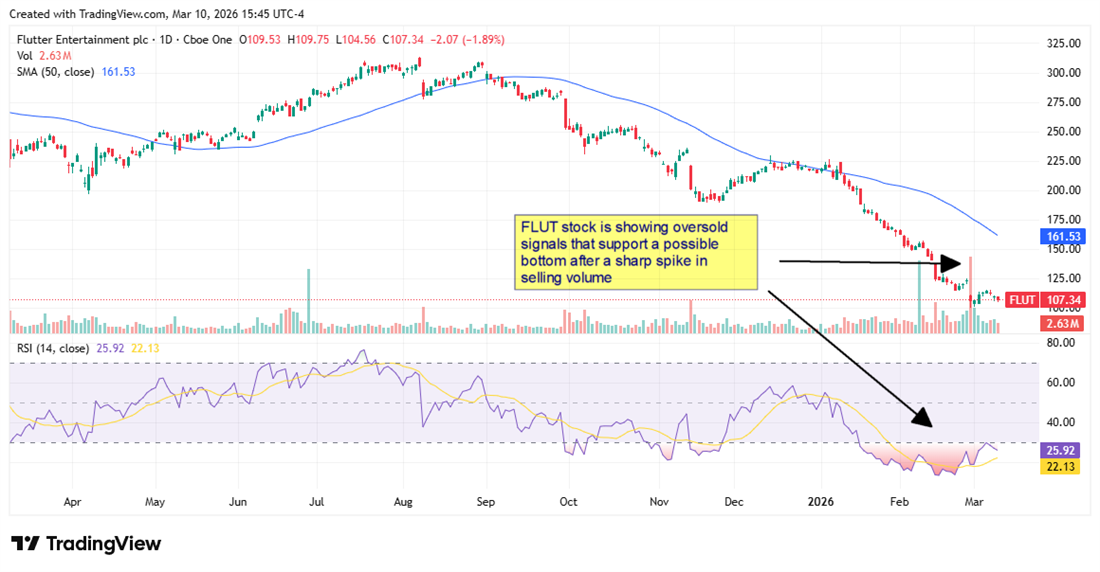
Investors haven’t been rewarding the company for that growth. FLUT stock is down over 50% in 2026. But, as is frequently the case in sports, you can’t call it a comeback if you don’t spot them a lead. The stock is showing clear oversold signals and is supported by a consensus price target that suggests roughly 100% growth in the next 12 months.